Where the Bank Holds: Riparian Woodland and the Slow Work of Water
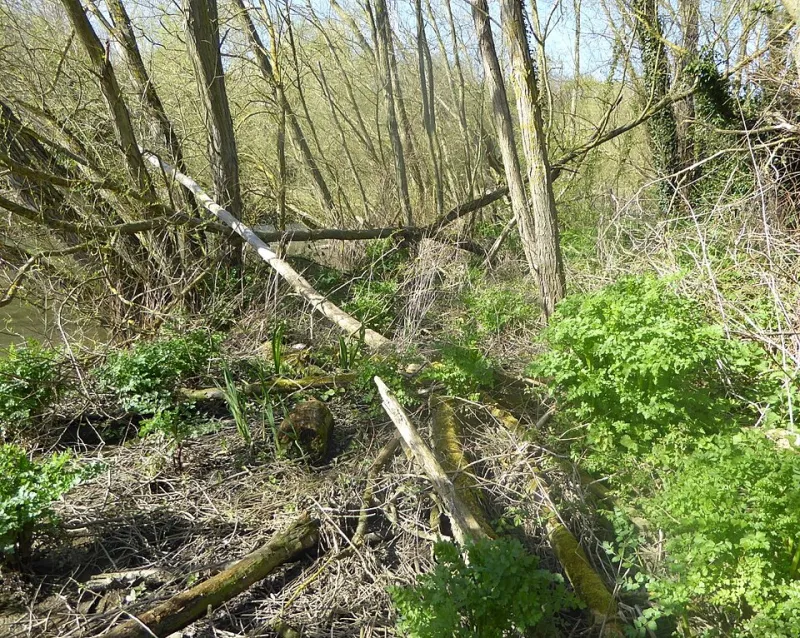
Photo: E Wusk, CC BY 4.0, via Wikimedia Commons
Stand on the footbridge above almost any lowland burn in Scotland and you can read two catchments in a single glance. Upstream, the water arrives fast and brown off bare improved pasture, cutting a raw edge into the bank. Downstream, where a band of alder and willow has been allowed to stay, the channel narrows, deepens, and runs clearer. The contrast is not merely aesthetic. It is the visible end of a long argument about what riverside trees do — and what they cannot be asked to do.
The Narrow Forest at the Water's Edge
Riparian woodland is the woodland that lives within reach of a watercourse: alder on the wet shingle, willow in the seepage, gean and bird cherry on the drier shoulder of the bank, hazel and oak where the ground lifts away. In Scotland it survives mostly as fragments — a wind-bent line along a policy burn, a gully wood in the Borders, a strip of alder carr behind a dike on the Carse. These are among the most modified habitats in the country, cleared for grazing, drainage and ploughing right up to the lip of the channel.
The ecological case for restoring them rests on a handful of mechanisms that are genuinely well described in the literature: shading and temperature control, bank reinforcement by roots, the addition of large woody debris, interception of sediment and nutrients, and the connectivity they give to a catchment that is otherwise fenced into compartments. The restoration case is strong. The flood case is more complicated, and it is the one that most often reaches the farming press.
What the Roots Actually Do
The mechanical work of a riverside wood is easy to underestimate because it happens out of sight. Alder and willow root into the bank itself, binding alluvial soil into a mat that resists the scour of spate flows. Where the bank is grazed bare, the same flow undercuts and collapses it, delivering a pulse of sediment downstream that smothers gravels and fills pools.
That sediment is not a trivial matter. Salmonid spawning gravels need clean interstitial flow; a bank collapse can degrade a reach for years. Stable, root-reinforced banks therefore do double duty — they keep soil on the holding and they keep the riverbed in condition for fish. For a tenant farmer with a poached crossing and a shrinking field margin, however, the same roots are the reason a fence line must be set back, and setback is the perennial point of friction.
Shade, Temperature and the Fish That Need It
Scotland's rivers are warming. The evidence from long-term monitoring is consistent: summer water temperatures in many small and medium catchments have risen, and the hottest days now press against the physiological limits of native fish. Brown trout begin to show stress in the low twenties Celsius; Atlantic salmon fare worse, with pronounced thermal stress above roughly 23°C and a well-documented preference for cooler, oxygen-rich water.
Riparian shade is one of the few levers that acts directly on this. Scottish guidance for salmonid burns commonly aims for 60–70 per cent shade over the channel in sensitive reaches, and field studies in the Tweed and Dee catchments have shown meaningful local cooling where a closed canopy is re-established. The effect is real but local: shade cools the reach, not the river.
Restoration here has an awkward practical constraint. Ash dieback has removed a species that many riverside woods relied on, and replanting plans must now lean on alder, willow, aspen and hazel rather than the ash that has dominated for decades. Alder, too, has its own troubles — Phytophthora alni has thinned stands across southern and eastern Scotland — so planting schemes need genetic and species diversity rather than a single substitute.
Fallen Wood: Mess as Mechanism
A natural river carries timber. In most managed Scottish burns it carries almost none, because fallen trees have been routinely cleared to protect bridges, culverts and fishing banks. Reintroducing large woody debris — pinned or hinged trees, log jams, brash berms — is among the most reliably evidenced techniques in natural flood management. Debris traps sediment, forces the flow to spread onto the floodplain, creates scour pools and cover for fish, and slows the passage of the peak.
The Eddleston Water project in the Borders, run by the Tweed Forum with research partners including the James Hutton Institute and SRUC, has become the best-documented test of these ideas in Scotland. Over more than a decade it has combined well over a hundred hectares of new riparian and floodplain woodland with hundreds of small leaky barriers and remeandered reaches. The findings are instructive: measurable but modest reductions in peak flow at the small-catchment scale, alongside clear gains in habitat and channel complexity.
The Farmer's Ledger
Where riparian restoration has struggled, it has usually struggled on economics rather than ecology. A buffer strip of six to ten metres takes productive ground out of use; wider setbacks of twenty metres or more are better for water but harder to justify on a tight margin. Fencing to exclude stock costs money and demands maintenance, and deer — where they are present in numbers — can undo a planting scheme within two winters unless protected.
Public funding has shifted to acknowledge this. Scottish Forestry's riparian woodland grants and agri-environment support now recognise buffer establishment, and the Riverwoods initiative, led by the Scottish Wildlife Trust with a wide partnership, has made the catchment-scale case in public. But grants are time-limited and tenancies are not always long enough to see a canopy close. A land manager weighing a thirty-year crop of trees against an annual subsidy is not being obstructive; they are doing arithmetic.
Where the Evidence Is Thinner
It is important to say plainly that riverside woods are not a flood defence. Reviews of natural flood management consistently find that woodland and debris measures attenuate peaks most effectively in small, steep catchments and in combination with other interventions — storage, floodplain reconnection, wetland creation. In large catchments such as the Tay or the Spey, the proportional effect on a major flood event is small.
What riparian woodland does well is different: it improves the condition of the channel over time, moderates temperature, reduces bank erosion and sediment delivery, and adds structural diversity that fish and invertebrates use. These are durable benefits that compound over decades. Framing them as flood prevention has, at times, set restoration up to fail.
A Working Compromise
The most convincing riparian schemes in Scotland are not the tidiest. They tend to be negotiated reach by reach: a fenced buffer where the bank is actively eroding, a lighter-touch approach where the ground is valuable, a hinge-pinned tree rather than a cleared one at the culvert. They accept that a working catchment is a compromise, and they are designed to be monitored rather than simply declared.
Stand on the footbridge again in twenty years and the difference may not be dramatic. It will be a deeper channel, a greener shadow on the water, a little more wood in the flow. In a country that has spent two centuries straightening its burns, that quiet accumulation is the point.