The Unlit Hours: Reading Scotland's Woodland Night Shift
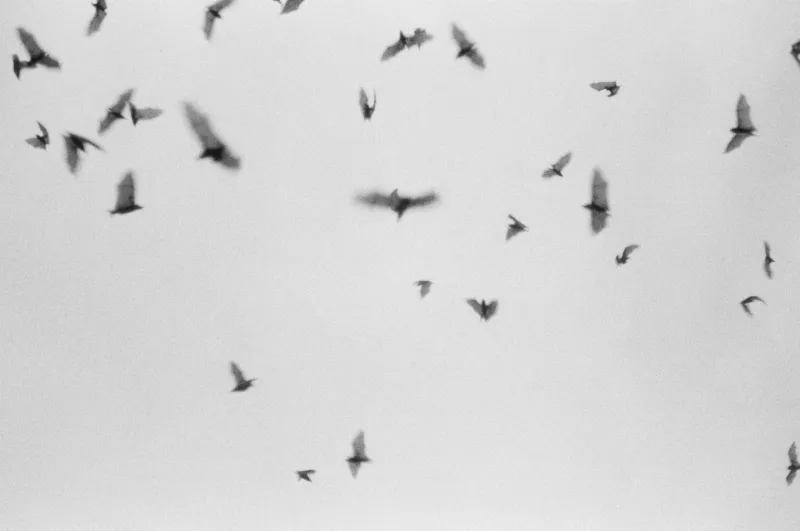
At dusk, a Scottish native wood changes hands. The diurnal cast withdraws — chaffinches settle, crane flies thin out, the last dog walker reaches the gate — and a less familiar economy begins. Bats leave roosts in old trees and crevices, moths lift from the field layer, and invertebrates that have waited out the day in damp litter start to move. For anyone accustomed to judging a wood by daylight, this can look like inactivity. It is better understood as shift work.
Coille Alba's interest in native woodland is usually framed by trees, ground flora and the structure of the canopy. Yet a wood that is dark at night is not simply a wood at rest. It is a habitat with its own routes, timings and vulnerabilities. Surveying it requires patience, modest equipment and a willingness to accept how much remains uncertain.
The first hour after sunset
Bat activity often begins before the light has fully gone. Soprano pipistrelles may appear while the sky is still grey, hunting small flies along woodland edges and over nearby water. Daubenton's bats favour lochs and slow rivers, taking insects close to the surface. Brown long-eared bats are more deliberate, gleaning moths and other prey from foliage rather than chasing at speed. In native pinewoods and Atlantic oakwoods, these species use different layers of the same wood, and their presence depends on more than the trees themselves: deadwood, hollows, wet flushes, rides and unlit margins all matter.
But detection is not the same as identification. A heterodyne bat detector is useful for orientation, while full-spectrum or time-expansion recordings allow more careful analysis. Even then, some species are difficult to separate confidently from sound alone. Surveyors increasingly use automated classifiers, but these are aids rather than verdicts. A record is strongest when it is supported by habitat context, repeat visits and, where necessary, licensed handling by suitably experienced people.
Moths and the pull of light
Moths are among the most revealing nocturnal groups in a wood, though they are also among the easiest to sample badly. A light trap can draw in hundreds of individuals, but the catch reflects the trap, the weather, the moon and the surrounding habitat as much as the wood's true assemblage. Some species come readily to light; others rarely do. A survey that relies only on a bright bulb will miss much of the nocturnal Lepidoptera that use the canopy, the scrub and the damp hollows.
This is where light pollution becomes more than a nuisance. Artificial light at night can pull moths away from natural navigation and feeding, concentrate them around lamps, and expose them to predators. For some species, a lit woodland edge may act as an ecological trap: attractive, but costly. The effect is not limited to the lamp itself. Skyglow and light spill can reach into the canopy and understorey, altering the conditions under which moths and other invertebrates move. A wood's edge is often where these pressures concentrate, because roads, car parks, farmyards and housing are rarely far away.
The damp economy beneath the canopy
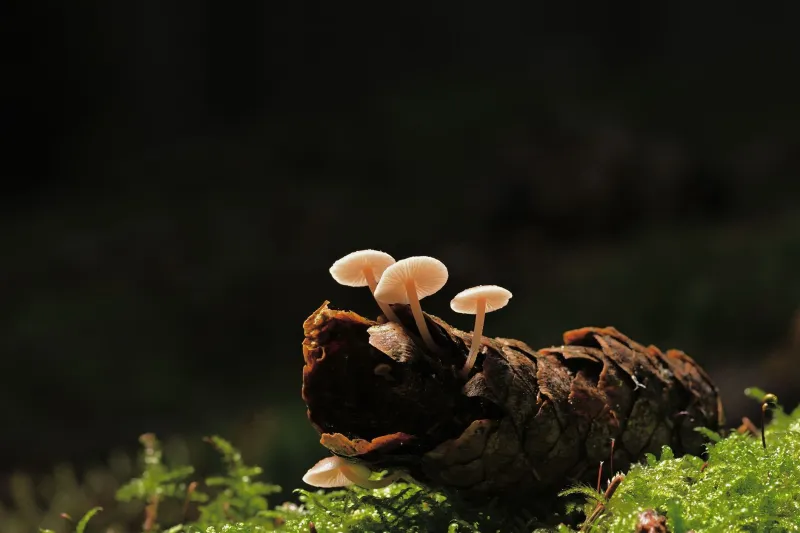
Not all nocturnal life is airborne. On mild, wet nights, the litter layer becomes busy with slugs, woodlice, spiders, harvestmen and springtails. Fungi, too, are part of this damp economy, though their fruiting bodies follow their own rhythms rather than a simple day-night switch. What changes after dark is the moisture and temperature profile of the wood, and the activity of animals that depend on it. These invertebrates are not incidental. They are food for bats, birds and small mammals, and they are the machinery that breaks down leaf litter and returns nutrients to the soil.
Because they are small and often overlooked, these groups are poorly served by casual observation. Structured survey — pitfall traps, leaf litter samples, fixed-point photography — can reveal more, but even these methods have biases. The scientific value lies less in a single spectacular record than in repeated, comparable observations over time.
The edge is where light leaks in
Woodland conservation has become increasingly alert to edge effects: the changes in temperature, wind, humidity and species composition that occur where a wood meets open ground. Artificial light adds another edge effect, and one that is often within our control. A security light aimed at a track, an unshielded lamp beside a car park or a brightly lit garden boundary can spill into woodland for many metres. The result is not a uniformly lit wood, but a wood with a brighter, more disturbed rim.
Management need not be complicated. Shielded fittings, warm-coloured bulbs, timers and motion sensors all reduce unnecessary illumination. Keeping dark buffers between native woodland and lighting, and directing light downwards rather than into the canopy, are practical measures. In some places, the most useful intervention is simply to leave a patch of wood unlit. Dark corridors between woodland blocks are especially valuable, not because darkness is rare in Scotland, but because continuous darkness is becoming less common.
Watching without taking
Responsible observation begins with restraint. A red-filtered torch used sparingly and kept low will reveal more than a bright beam swept through the canopy. Bat detectors should be used passively; playback is not a harmless way to bring bats closer and may disturb them. Roosts, whether in trees, buildings or bridges, should never be approached or illuminated. Bats are legally protected in the UK, and any survey involving disturbance or handling requires the appropriate licence and experience.
Moth trapping also carries responsibilities. Traps should be checked frequently, sheltered from rain and wind, and never left running unattended through a cold night. In the morning, moths should be released carefully into cover. Records sent to local biological recording centres or national schemes add lasting value, provided they are accurate and responsibly obtained.
The night shift is not a separate curiosity tacked onto woodland conservation. It is part of how a native wood functions. To protect Scotland's woods in 2026 and beyond, we need to value the unlit hours as deliberately as we value the trees, the flowers and the daylight birds. A wood that is allowed to be dark is not a wood left alone. It is a wood still working.