What Lies Beneath the Pines: A Measured Look at Woodland Fungal Networks
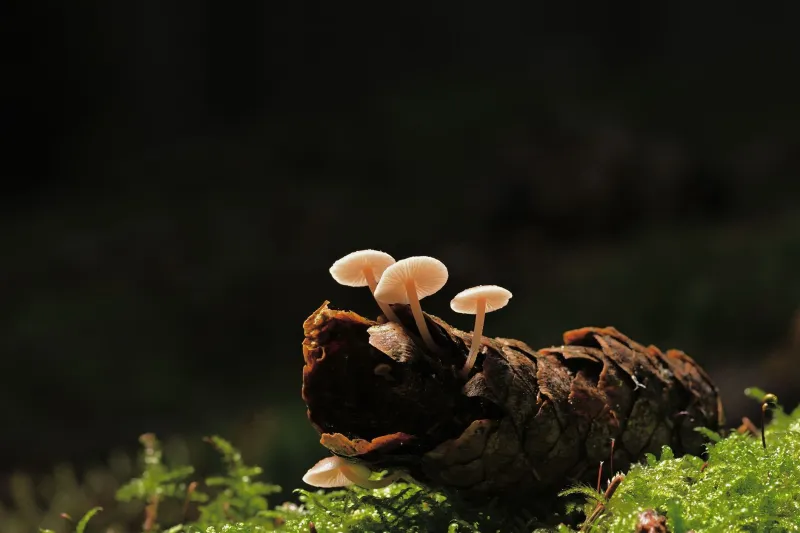
On a damp October walk through a Caledonian pinewood, it is easy to believe the popular story. Beneath the needles, fungal threads are said to form a 'wood wide web', a natural internet through which trees trade sugars, send warnings and nurse their young. The image is powerful. It has changed how many people see a forest floor. It has also encouraged a good deal of overstatement.
A metaphor that got away
The 'wood wide web' phrase caught on because it makes an invisible world vivid. Mycorrhizal fungi are real, widespread and ecologically vital. Most plants form partnerships with fungi. In Scottish native woodlands, ectomycorrhizal fungi associate with pine, birch, oak, hazel and willow; ericoid fungi with heather; arbuscular fungi with many grasses and herbs. The fungi explore soil for water and nutrients, especially phosphorus and nitrogen, and receive carbon from plants. That much is not in doubt.
What is less certain is the scale and meaning of the networks. Fungi can link roots of different plants, and experiments have traced carbon movement between trees. But tracing carbon is not the same as showing a tree deliberately sending aid. Carbon may move through fungal tissue, through soil, or through repeated transfers that benefit the fungus more than either plant. Labelling studies are clever, but they often simplify complex soil food webs. The result is a body of evidence that is genuinely interesting and genuinely incomplete.
Where the story outruns the evidence
Popular accounts often slide from 'fungi connect plants' to 'trees communicate'. The second claim is much harder to test. A warning signal, a resource transfer or a mother tree nurturing seedlings all require specific evidence: that a signal moves, that a receiver responds, and that the response benefits the receiver in a real woodland. Some studies suggest such effects; others find none, or find that the fungi are the main beneficiaries. The scientific debate is active, and that is healthy. It becomes a problem when a memorable metaphor is repeated as settled fact.
Scottish woodlands add their own complications. Our native woods are diverse: pinewoods on deep podzols, Atlantic oakwoods in wet western glens, birchwoods on drier slopes, ash and hazel copses on richer soils. Each has different fungi, different soils and different histories of grazing, planting and drainage. A finding from a temperate forest elsewhere may not transfer neatly to a Scottish glen. Conservation decisions should be based on local evidence, not on a simplified global story.
Why nuance helps conservation
The practical message is not that fungi matter less. They matter more. Mycorrhizal fungi are part of the soil ecosystem that supports woodland resilience. They help trees acquire nutrients, influence seedling establishment and respond to drought. They are also vulnerable to compaction, cultivation, nutrient enrichment and soil disturbance. In Scotland, poorly planned tree planting, drainage, fertiliser use and heavy machinery can damage the very fungal networks that a new woodland will depend on.
The 'internet' framing can obscure these risks. If people believe the forest is a self-organising network that will simply repair itself, they may undervalue the soil. A more accurate story is that fungi are partners with limits. They need organic matter, stable structure, host roots and time. Ancient woodland soils are especially valuable because they have accumulated these relationships over centuries. Once compacted or eroded, they are not easily replaced.
For outdoor learning, the lesson is about uncertainty. Children and visitors can be taught to see fungal threads, toadstools and root partnerships without being told that science has proved a forest internet. Wonder does not require exaggeration. A question such as 'what might this fungus be doing?' is more honest, and often more engaging, than a confident claim about talking trees.
Practical notes for visitors and volunteers
Walkers can help by staying on established paths where soils are vulnerable, especially in wet weather. Soil compaction is quiet but cumulative. Do not dig or rake leaf litter to look for fungi. If you photograph fruiting bodies, leave them in place; many are part of a larger organism, and some sites are sensitive. Record what you see through a recognised scheme, such as iRecord or a local fungus recording group, rather than picking specimens without permission.
Volunteers and land managers can argue for deadwood retention, minimal soil disturbance and careful planning of access. Tree planting should respect existing soils and fungi, not just hit a target for trunks per hectare. Where ancient woodland is present, protection and buffering are usually more valuable than intervention. And in education, we should teach the difference between a hypothesis, a finding and a headline.
A better story than Wi-Fi
The forest floor is not a Wi-Fi network. It is something stranger and more interesting: a shifting partnership of roots, fungi, bacteria, invertebrates and soil. The evidence for connection is strong enough to inspire care, but not strong enough to justify every claim. For Scottish woodland lovers, that is a useful discipline. We can be sceptical and still be captivated. We can protect the soil without pretending to know exactly what every fungal thread is saying.