The Pools That Keep Their Own Time: Winter Water in Scotland’s Native Woods
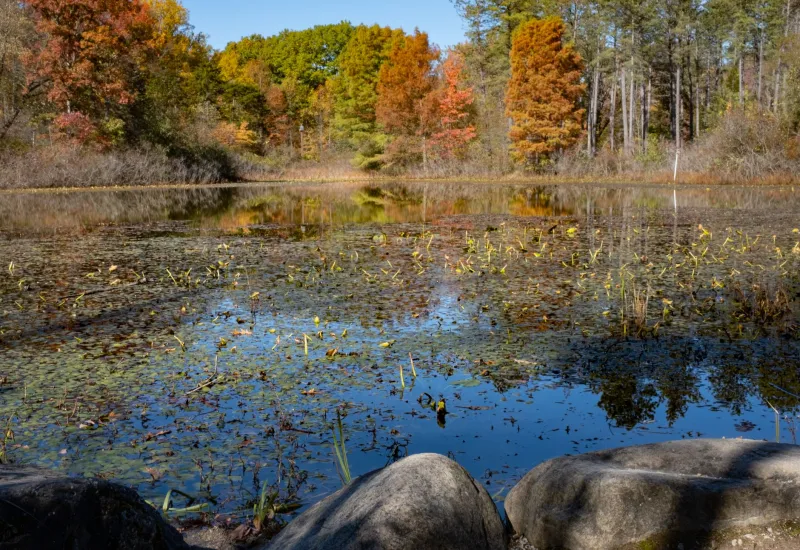
On a cold morning in a Scottish native wood, a shallow pool can be easy to miss. It may be no larger than a dining table, ringed by rushes and half-hidden under alder leaves. In November it might hold nothing more than brown water and a few floating birch leaves. By February it could be the centre of a small, urgent breeding season.
These are temporary woodland ponds: small waterbodies that fill in autumn and winter, then dry in spring or summer. They are among the most overlooked habitats in the countryside, and among the most revealing. Because they have no fish, they offer refuge to amphibians and invertebrates that would otherwise be eaten. Because they dry, they support species adapted to uncertainty. And because their water regime is sensitive to weather, they act as quiet indicators of a warming climate.
A small waterbody with a large mandate
Temporary ponds form in hollows, old track ruts, former quarries, glacial depressions and the margins of flushes. Some are centuries old; others appear after a single wet winter. In native woodland they are often associated with alder, willow and birch, where the ground stays damp and the canopy keeps evaporation moderate. They may be only a few centimetres deep, but their ecological role is disproportionate.
Common frogs and palmate newts are the familiar occupants. Smooth newts and common toads may also use them, and in some parts of Scotland great crested newts depend on larger pond complexes. The absence of fish is critical. Amphibian eggs and larvae are vulnerable to predation, and a seasonal pond that dries before fish can establish offers a temporary safe haven. The same applies to many invertebrates: water beetles, caddisflies, dragonfly nymphs and small crustaceans can thrive in fishless water.
The plant communities are equally distinctive. Expect rushes, sedges, marsh pennywort, water starwort and mosses that tolerate both inundation and desiccation. Some plants survive dry periods as seed or buried rootstock. Others appear only in years when the water persists long enough. The pool is not a fixed feature but a shifting one, and its species reflect that variability.
How a woodland pool keeps time
Freshwater ecologists describe a pond’s wet-and-dry cycle as its hydroperiod: the length of time it holds water each year. The hydroperiod determines which species can complete their life cycles. A pool that dries in June favours amphibians that metamorphose early. A pool that holds water into August may support different invertebrates but could also allow predators to persist.
In winter, the cycle is driven by rainfall, temperature and the shape of the ground. A mild, wet winter can keep pools full for months. A sharp frost can freeze them over. A dry spell in late winter can lower water levels just as frogs begin to spawn. These variations are natural, and native species are adapted to them. The concern is not that ponds vary, but that the pattern of variation appears to be changing.
A warmer winter, a less certain calendar
Milder winters and more erratic rainfall are reshaping the timing of woodland ponds. In some years, shallow pools warm earlier than they once did, prompting amphibians to breed sooner. A subsequent frost can kill exposed spawn. In other years, heavy rain fills pools late, or prolonged wet weather keeps them full into the breeding season, altering the balance between amphibians and their predators.
Erratic summer rainfall matters too. A pool that reliably dried in July may now hold water into autumn, or may fail suddenly after a dry spring. For species with short larval stages, the difference between a few extra weeks of water and a few lost weeks can determine whether a generation succeeds.
The effects are not uniform. Deeper ponds may buffer change better than shallow ones. Woodland shade may slow warming, while exposed pools react faster. Long-term records are therefore valuable. A single observation of frogspawn is a useful data point; repeated observations from the same pool over many winters begin to show a pattern.
What to record, and what to leave alone
Recording a woodland pond need not involve entering it. Indeed, the most responsible approach is to stay on the bank. Note the date, approximate size and location of the pool, preferably with a grid reference. Record whether it holds water, how deep it appears at its deepest point, and whether there is ice cover. A walking stick or a marked stick can be used to gauge depth without wading.
Look for field signs rather than specimens. Frogspawn is usually laid in clumps; newt eggs are often wrapped singly in folded leaves. Larvae can be observed from the edge with care. Adult amphibians may be seen under logs or leaf litter nearby, but these should be left undisturbed. Great crested newts are legally protected, and any handling or habitat disturbance requires care and, in many cases, a licence.
Photographs taken from the bank are often more useful than collected samples. Images of spawn, water level and surrounding vegetation can be submitted to a local biological records centre or to a national recording scheme such as iRecord. Records of absence are valuable too: a pool that is dry on a given date is part of the same story.
Biosecurity matters. Footwear and equipment should be cleaned between ponds to reduce the risk of spreading disease or invasive species. Spawn, tadpoles and plants should never be moved between sites. The aim is to document the pool as it is, not to rearrange it.
The value of ordinary observations
Woodland ponds are not remote wilderness. Many lie beside paths, in copses and on the edges of farms. That makes them accessible to anyone with a notebook and a reasonable pair of boots. For Coille Alba, their value lies in that ordinariness: a pond that can be visited every few weeks, in the same way, by the same person, becomes a modest but genuine climate record.
The long thaw of a Scottish winter is not a single event. It is a series of small shifts in water, ice and timing. In the smallest pools, those shifts are visible first. Recording them carefully, and leaving the inhabitants to get on with their lives, is one of the least intrusive ways to understand what is happening in Scotland’s native woods.