The Buried Harvest: How Caching Animals Shape Scotland’s Next Native Wood
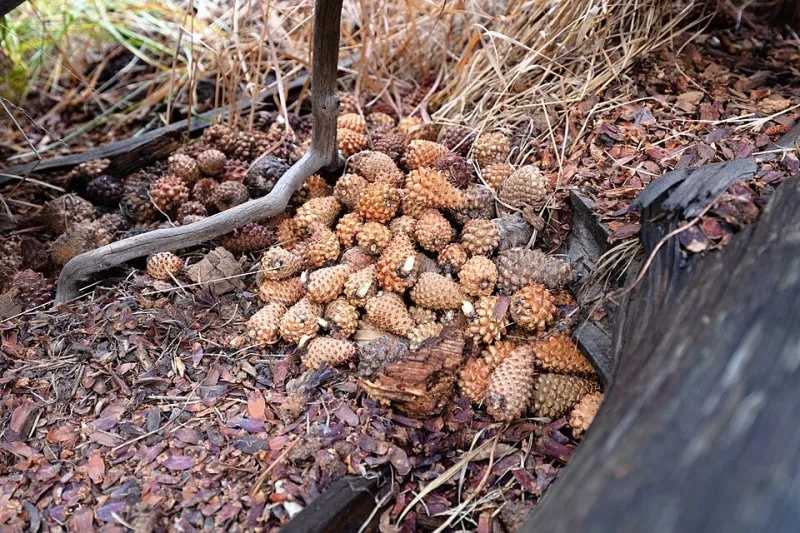
Photo: Yellowstone National Park, Public domain, via Wikimedia Commons
A wood does not always begin where a forester intended. Across Scotland, some of the most effective tree planters are small, furred or feathered, and entirely uninterested in woodland policy. Red squirrels and jays cache thousands of seeds in autumn; a proportion is never recovered. Those forgotten stores can become the next generation of native trees.
The language of accident is tempting, but it understates what is happening. Scatter-hoarding is a deliberate behaviour with ecological consequences. Understanding it gives woodland managers a more measured view of natural regeneration — and a practical reason to treat caching animals as part of the wood’s infrastructure rather than as incidental wildlife.
The mechanics of scatter-hoarding
Scatter-hoarding describes the practice of burying individual food items in many small caches rather than concentrating them in one store. The strategy spreads risk: if a competitor or a hungry animal finds one cache, the rest may survive. For the tree, the same behaviour spreads seed across the landscape.
Red squirrels are well known for caching hazelnuts and pine cones. In Scottish native woods, hazel is a particularly important autumn resource, and pine seeds are taken where Scots pine is present. The squirrels recover many caches by memory and smell, but recovery is imperfect. Some seeds remain buried beyond the point at which they might have been eaten, and a fraction germinates.
Jays are equally significant, especially for oak. An individual jay may cache thousands of acorns in a single autumn, often carrying them some distance from the parent tree and burying them in soil or leaf litter. The bird recovers many, but enough are missed to make jays one of the most important dispersal agents for oak in Britain and Ireland. In Scottish oakwoods, that relationship is part of how the wood has spread and how it might continue to spread.
The result is not random. Caches tend to be placed in accessible ground, often near cover, and the animals’ preferences shape where seedlings appear. A young oak far from any mature oak may be the visible outcome of a jay’s autumn work. A hazel thicket in an unexpected corner may owe something to a red squirrel’s forgetfulness.
Why this matters in Scottish native woods
Natural regeneration is rarely a simple matter of seed falling to the ground. Seed predation, browsing, competition and ground conditions all intervene. Scatter-hoarding adds a dispersal step that can move seed away from the parent tree, into disturbed ground or beyond a stand boundary. That movement can be ecologically valuable, particularly where woods are fragmented or where managers hope for gradual colonisation rather than planting.
Oak and hazel are obvious beneficiaries. Both produce heavy seeds that do not travel far on the wind, so animal dispersal matters disproportionately. Jays can move acorns across open ground; red squirrels can move hazelnuts through scrub and along woodland edges. In pinewoods, red squirrels contribute to the dispersal of pine seed, although the relationship is complicated by cone crops, competitor species and the wider condition of the wood.
The science also cautions against overstatement. A cached seed is not a guaranteed tree. Many caches are recovered; others are taken by mice, voles or other animals; some germinate but are browsed before they can establish. The contribution of caching animals is best understood as one influence among several, not as a substitute for good woodland management.
Field signs to look for
Caching animals are often secretive, but their work leaves traces. In hazel woods, look for hazelnut shells opened in characteristic ways. Red squirrels typically split or gnaw the shell in a distinctive manner, leaving a neat opening; the exact pattern differs from the untidy nibbling of small rodents. Stripped pine cones, often reduced to a central core, indicate squirrel feeding. These signs show that animals are using the wood’s seed resource, not that every cache will become a seedling.
Jays are harder to observe, but their consequences can be conspicuous. Look for young oak seedlings in field margins, hedgerows, scrub and woodland edges some distance from mature oaks. Clusters or lines of seedlings can reflect cached acorns. The birds themselves may be seen carrying acorns in autumn, usually in short flights between trees and open ground.
A word of caution is warranted. Field signs are indicative, not diagnostic. The presence of seedlings does not prove a jay planted them, and the absence of visible caches does not mean caching is unimportant. The aim is to build a picture of how seed is moving through the wood, not to assign credit too precisely.
Working with the planters
For woodland managers, the practical question is how to support natural regeneration without reducing it to a passive hope. The first principle is to retain seed sources. Mature oaks, hazels and pines are the engine of the system; a wood without them has little for caching animals to move. Retaining a proportion of mature trees, including some in less convenient places, is a reasonable starting point.
Deer pressure is the second consideration. A cached acorn that germinates into a seedling is only useful if the seedling can grow beyond browsing height. In many Scottish woods, deer density is a more immediate constraint on regeneration than seed supply. Monitoring browsing and managing deer at a level that allows seedlings to establish is likely to do more for natural regeneration than any attempt to manipulate caching behaviour.
The third principle is to tolerate a degree of untidiness. Scatter-hoarding works best where there is cover, rough ground and a mosaic of habitats. Over-tidy woodland edges, close-mown margins and the removal of scrub can reduce the places where animals cache and where seedlings might establish. A measured approach to woodland edges and open ground is therefore part of supporting the system.
Direct intervention should be treated with caution. Feeding animals to encourage caching is not a reliable conservation measure and can create dependencies or concentrate animals in ways that increase disease risk. The better approach is to protect the habitat and the seed resource, and to let the relationship function as it has done for centuries.
A partnership with limits
The appeal of the caching animal is that it offers a form of natural regeneration that costs little and works at a landscape scale. That appeal is real, but it is not unlimited. Caching animals can move seed; they cannot compensate for absent seed trees, heavy browsing or impoverished ground. They are partners in regeneration, not a replacement for management.
In 2026, as Scottish woodland policy continues to emphasise natural processes and resilience, the humble cache deserves a place in the conversation. A wood’s future may depend, in part, on what a squirrel forgets and what a jay buries. The task for managers is to give those small planters the conditions in which their work can succeed.