After the Gale: What a Storm-Battered Wood Needs, and What It Does Not
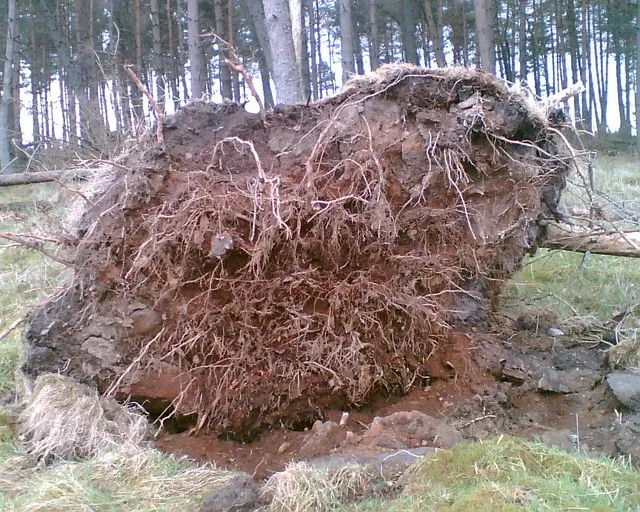
Photo: Ballogie, CC BY-SA 2.0, via Wikimedia Commons
There is a particular quiet after a major storm in a wood. Not silence — there is usually water moving, and the odd creak — but a kind of stunned stillness, broken by root plates the size of garage doors standing at unlikely angles. Anyone who has walked a Scottish wood after Storms Arwen or Éowyn will recognise it: the sense that something fundamental has been rearranged.
It has. But rearrangement is not the same as ruin.
The anatomy of a blowdown
Windthrow is not random. Uprooting tends to cluster along newly exposed edges, on thin or waterlogged soils, and in stands that have grown tall and slender in shelter. Trees on shallow, peaty or gleyed ground hold weakly; those on deep, well-drained soils root more securely. Recent thinning can leave a stand suddenly exposed and unstable, although the same thinning, done earlier and more gradually, is one of the best remedies against exactly this.
Windthrow is only one mechanism. Windsnap breaks stems cleanly, often part-way up, leaving standing snags. Branch shedding strips limbs from healthy trees without killing them. Coastal woods can take salt burn into the canopy, which shows as browning the following spring. And the second storm is often worse than the first, arriving while the wood is already opened up.
Mapping what happened is the first piece of useful work. Aerial imagery, drone survey or a slow walk with a map will show the pattern: edge damage, topographic funnelling, soil-related failures, and species differences. The pattern is the lesson.
Why a wrecked stand is not a ruined one
In an ecological sense, storms are a normal disturbance. Native woodland in Britain has experienced them for millennia, and a good deal of its biodiversity depends on the consequences.
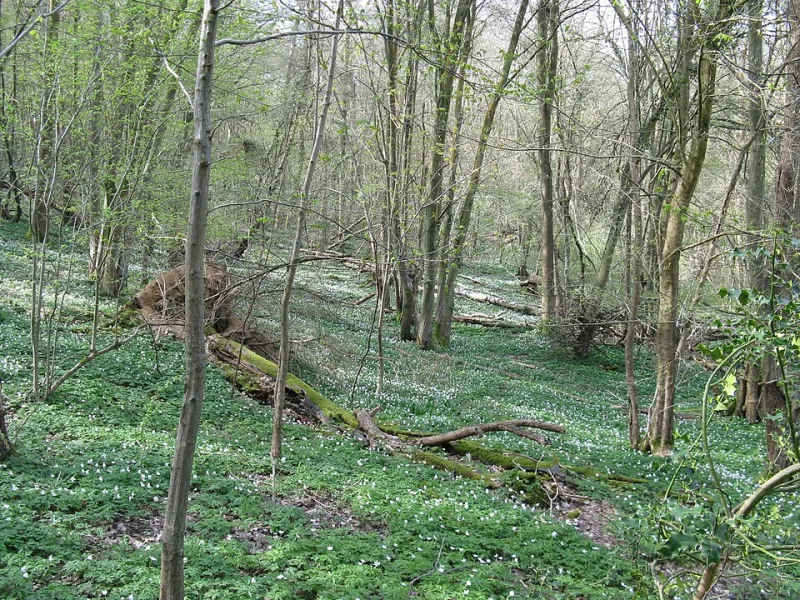
Uprooted trees leave pits and mounds, a micro-topography of damp hollows and drier humps that supports a different flora from level ground. Canopy gaps admit light, briefly, and stimulate ground flora and regeneration. Deadwood — trunks, snapped stems, shattered limbs, and the root plates themselves — is habitat rather than waste: saproxylic beetles, fungi, lichens and bryophytes all follow it. Standing dead stems become nest sites for woodpeckers and roosts for bats long after they cease to be trees in any commercial sense.
The important qualification is that storms are only ecologically benign in woods that have somewhere to regenerate from. Where deer pressure is high, a gap fills with nothing but more grass. Where the wood is a small fragment in arable land, the gap may simply be colonised by whatever the wind carries in.
Before anything else: safety, law and species
Damaged woodland is dangerous. Leaning stems under tension, hung-up branches and partially fallen trees can release without warning. Keep people out of affected compartments until an arborist or competent forester has assessed them, and never send volunteers in to cut up windblow without a proper risk assessment, training and personal protective equipment. Around public paths, the priority is making the boundary safe rather than rescuing timber.
Scotland has its own regulatory framework. Felling generally requires permission from Scottish Forestry, though there are exemptions — for trees that present an immediate danger, for small volumes, and in certain other defined cases. Restocking conditions usually attach to any permission granted, so a salvage operation is not a decision to leave the land bare. Windblown timber also has a limited window before it stains and loses value, which is why owners are often under pressure to act quickly; that pressure is a reason to take advice, not a reason to skip it.
The Wildlife and Countryside Act 1981 protects nesting birds, and bats and their roosts are protected even within a fallen tree. In practice this means scheduling work outside the main breeding season where possible, and taking advice before felling anything that may hold a roost. Plant health law may also dictate removal: larch within Phytophthora ramorum zones, and spruce where Ips typographus has been found, are examples where statutory notices override the general preference for leaving deadwood.
The case against tidying
The most common mistake after a storm is over-cleaning. Removing every fallen stem, burning the brash and extracting the roots turns a complex habitat into a tidy but impoverished field.
A more measured approach is to salvage what is safe and economic to remove — timber in accessible places, on good ground, close to a road — and to leave a meaningful proportion on site. Coarse woody debris left in scattered heaps or single stems retains much of its habitat value without obstructing access. Standing broken stems, where they pose no risk, should generally be kept. Root plates, unless they are in the way or unsafe, are best left as they fall.
There are caveats. Deep brash mats can smother ground flora and suppress regeneration, so distribution matters more than total volume. Machinery working on wet ground in winter will do more lasting damage to soils than the storm did to the trees. And on nutrient-poor sites, exporting material removes nutrients; on enriched sites, it may be helpful. A site-specific plan is worth far more than a general rule.
Where intervention genuinely pays
Some work after a storm is worthwhile, and it falls into a few categories.
Reshaping exposed edges is the clearest. A hard, straight edge of standing timber facing the prevailing wind will continue to lose trees for years. Feathering that edge — thinning progressively and encouraging a graded transition of lower growth — reduces the risk of progressive loss. Where a gap has opened, deciding early whether to allow natural regeneration or to plant is easier than deciding later, when a dense sward has established.
Deer management is the pivot on which most of this turns. Without control of browsing pressure, canopy gaps produce little more than grass and rank vegetation. Temporary fencing can work for small areas but is expensive, needs maintenance and creates its own hazards; it is often better to invest in sustained deer management across a wider area.
Restocking should favour diversity, both of species and of structure, and should be organised around the wind pattern the storm revealed rather than in spite of it. Replanting the same susceptible species in the same exposed position simply resets the clock.
Planning for the next one
Attribution of windstorm trends to climate change is less certain than attribution of rainfall and temperature trends, and it is honest to say so. What is clear is that woods facing heavier winter rainfall, wetter soils and more frequent drought stress will be less robust to wind, and that diversity of species, age and structure is the most reliable insurance available.
That means thinning earlier and more often to build windfirm trees. It means retaining understorey and scrub rather than managing for a single clean canopy. It means keeping some deadwood as a matter of routine, so that the wood is never starting from zero. And it means recording what happened: photographs, fixed-point plots, notes on which species failed and where. The next storm will ask the same questions, and the answers are best written down while the ground is still wet.