When the Wood Wakes Early: Phenology and Mismatch in a Scottish Spring
The first cuckoo call is still one of the most reported signs of spring in Scotland. It arrives by telephone, by text and, increasingly, by app: a note that the season has turned. But the cuckoo is only one entry in a much longer ledger. Across Scotland's native woods, trees, insects and birds are keeping time by different clocks — and those clocks are beginning to drift apart.
Phenology is the study of seasonal timing: when a tree bursts into leaf, when an insect hatches, when a bird returns or begins to nest. It is one of the most sensitive natural records we have, because it responds directly to weather. It is also one of the easiest to observe. A single oak, watched closely over several springs, can tell you more about a changing climate than a headline figure.
The calendar inside the tree
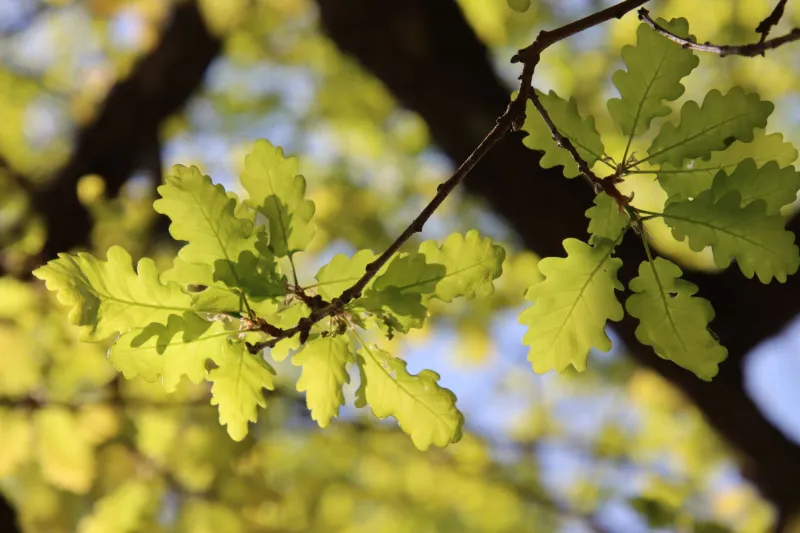
A tree does not leaf out on a fixed date. Its buds respond to a combination of winter chilling and spring warmth, with day length setting the outer limits. Sessile oak, the mainstay of many western Scottish oakwoods, and pedunculate oak, more common in the east, both need a period of cold before they will respond fully to warmth. Once that requirement is met, a run of mild days in March or early April can move budburst forward by a week or more.
That sounds like a simple benefit: an earlier start, a longer growing season. In practice, the calculation is more cautious. Early budburst exposes young leaves to late frost, and Scottish springs are well practised at delivering frost after warmth. A tree that leafs too soon may lose its first crop of leaves to a cold night. It can recover, but recovery costs energy, and the replacement leaves may be less vigorous.
This is why native trees tend to hedge. Budburst is not a single date but a spread of dates across a wood, a population and a species. Some individuals run early; others hold back. That variation is the wood's insurance policy, and it is one reason why a woodland is more resilient than a single tree.
The caterpillar window
For many woodland birds, the critical event is not leaf emergence itself but the caterpillar peak that follows it. Winter moth caterpillars, among others, hatch in spring and feed on young oak leaves. Their biomass rises quickly and then falls as they pupate. The peak may last only two or three weeks.
This narrow window is one of the great, unnoticed events of the woodland year. It is the point at which a wood converts sunlight into insect protein at maximum speed, and it is the reason why blue tits, great tits and pied flycatchers time their nesting so precisely. Chicks need caterpillars, and caterpillars need young leaves. The three are linked in a chain of timing that has been refined over thousands of years.
When spring runs early, the chain can stretch. If oak budburst advances faster than the caterpillars can respond, the insects may hatch before leaves are suitable, or the peak may pass before chicks hatch. If the caterpillars advance but the birds do not, the nest may be provisioned after the abundance has gone. Researchers describe this as trophic mismatch: a misalignment between the timing of food and the timing of the consumer.
Migrants on a different clock
Resident birds such as blue tits can adjust their laying dates from year to year, within limits. Long-distance migrants have a harder problem. Pied flycatchers, wood warblers and cuckoos arrive in Scotland after journeys shaped by conditions in southern Europe and Africa. Their departure and arrival are cued by day length, weather and inherited routes. A bird cannot advance its migration simply because an oak in Perthshire has leafed early.
This does not mean every migrant is in trouble. Some species are more flexible than others, and local conditions matter. But the direction of the risk is clear. Where a woodland food web depends on a tight sequence — leaf, caterpillar, chick — a widening gap between the first and the third is a source of pressure.
The cuckoo is a useful cultural marker rather than a perfect scientific index. Its call tells us that spring has reached a certain point, but the bird's own breeding strategy depends on the nests of other species, chiefly dunnocks and meadow pipits in many Scottish landscapes. The cuckoo's timetable is a reminder that a wood is not a single clock. It is many clocks, and they do not all agree.
Why an early spring is not a gift
It is tempting to read a mild March as good news. After a long winter, warmth feels like generosity. For a woodland, it is more ambiguous. Early warmth can bring a false spring: a flush of growth followed by frost. It can dry soils earlier in the season. It can advance some species while leaving others behind.
The effects are rarely uniform. A warm spring may favour one insect species and disadvantage another. It may help a tree whose buds are ready, and harm one whose buds are not. It may allow an early nesting attempt to succeed in one year and fail in the next. The wood is not a machine with a single dial. It is a community of species, each with its own sensitivity.
What matters is not whether spring is early in any one year, but whether the relationships between species hold together. A single early spring is weather. A run of early springs is climate. The difference is written in long-term records, and those records depend on people who notice the ordinary.
What to watch, and how to record it
For anyone who walks in Scotland's native woods, phenology offers a way of looking that costs nothing and sharpens everything. Choose a tree you can visit regularly — an oak on a woodland edge, a birch by a path. Record the date when buds first begin to break, and the date when leaves are fully unfolded. Note the first caterpillar you see on a leaf, the first cuckoo you hear, the first pied flycatcher you glimpse.
These observations are most useful when they are repeated. A single year is an anecdote; a series is evidence. Schemes such as Nature's Calendar, run by the Woodland Trust, and surveys coordinated by the British Trust for Ornithology and the Scottish Ornithologists' Club rely on such records. They do not require expertise. They require consistency, a notebook and a willingness to write down the date.
In 2026, as in any year, the most valuable observation may be the least dramatic. The first leaf on a familiar tree. The first call from a remembered clearing. The ordinary signs, recorded carefully, become the raw material for understanding how Scotland's woods are changing.
Reading the wood's timing
The cuckoo's timetable is not merely a folk curiosity. It is an index of how the season is assembling. When the wood wakes early, the consequences are not immediately visible. They are written in the success or failure of nests, in the survival of caterpillars, in the frost damage on young leaves. They are written in dates.
Scotland's native woods are not passive. They are communities in motion, adjusting to each year's weather while carrying the memory of many springs. The question is not whether spring will arrive early, but whether the wood's many residents can stay in step. The answer will be written in dates, and anyone with a notebook can help read them.